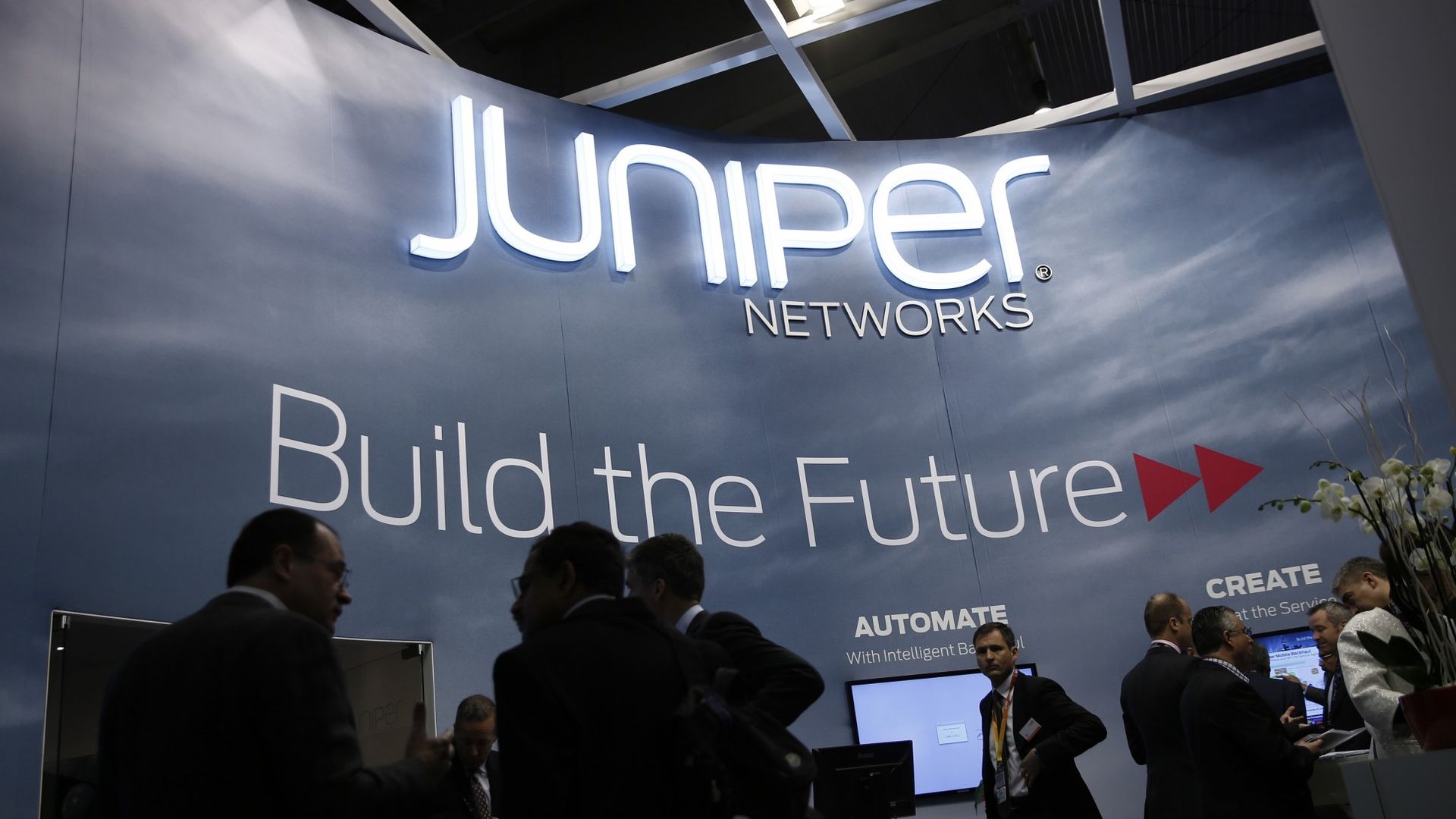
Nike has announced a multi-year partnership with Juniper to redevelop Nike's data center infrastructure.
The idea of “outsourcing” the network and/or IT functions to a provider—or keeping them in-house—is a decades-old strategic debate. Often, the justification presented to the CEO and the Board revolves around acronyms like TCO and ROI or operational efficiency. The reality often ends up quite different from the original business case.
There is no single correct answer for all companies. It all comes down to their business challenges and needs.
At Juniper, they’re helping companies decide whether or not to own the infrastructure and the applications running on it as they move further into the cloud era, or to own part of it and outsource part of it to IaaS or SaaS providers.
Data-driven IT companies value and recognize that their customers are more important than ever.
A key difference between winning and losing is a company’s ability to gather data from the market, connect it to the people who will come up with the next big idea, and then translate that idea back into new products or services.
There’s a very good reason why companies like Tesla, Starbucks, UBS, and Nike are leaders in their markets.
They understand this value chain process and have a holistic perspective that encompasses both building and connecting to the cloud. Data is fundamental to future growth and success, as it provides better “high-IQ” insights into what is happening with their customers and markets.

Another common trend is that customers are looking for partners who can help them capitalize on this need for agility, speed, and intelligence and transform their networks and IT capabilities.
When companies undergo this transformational shift—moving from viewing IT purely as a cost center to seeing the network as a strategic, agile asset and a key differentiator for their business and brand—they turn to Juniper. “We know what it takes to build the next generation of clouds, what it takes to make a network smarter, and how to incorporate more automation to operate at a lower cost,” Juniper states.
Delivering business value and market penetration is at the core of Juniper’s strategy. By working closely with its customers, Juniper identifies the best ways to leverage new and emerging network technologies and apply them to its customers’ most significant business challenges through a process they call “co-creation.”
By connecting the ideas of Juniper’s customers and leveraging its networks, Juniper enables new levels of creativity, progress, and success.
Nike’s Chief Information Officer, Anthony Watson, said, “We’re eager to partner with Nike to help them achieve their business goals, and we’d like to do the same for more companies.”
Nike chose Juniper Networks to deploy a high-IQ network and also plans to use Juniper’s SDN MetaFabric architecture to adapt to Nike’s changing business needs and make future goals more achievable. MetaFabric will also serve as the foundation for the virtualization of Nike’s various data centers worldwide.
As part of the agreement, Juniper will help Nike redesign its network architecture across the company’s global data centers; according to Nike, this will serve as the foundation for the virtualization of its IT systems.
Juniper Networks is committed to providing Nike with a carrier-class, ultra-scalable, secure network framework, as well as advanced orchestration through automation, management, and data analytics across all of Nike’s domains. Under the agreement, the two companies will also explore future developments to help advance Nike’s network on its journey.
Nike said it plans to implement Juniper’s MetaFabric solutions—a portfolio of switching, routing, orchestration, software-defined networking, and security tools—which the vendor claims help accelerate the deployment and delivery of applications within and across multiple data centers, and simplifies network management.
According to Nike Chief Information Officer Anthony Watson, the partnership is designed to help the retailer implement a cloud-centric architecture that is more responsive to changing business demands.
“Nike is focused on elevating and accelerating innovation in products, services, and our digital ecosystem,” Watson said. “This requires progressive and agile technology solutions that keep pace with our growth,” he added.
Shaygan Kheradpir, CEO of Juniper Networks, commented on the agreement: “Companies are reengineering their business models based on evolving customer behavior and emerging technologies. Managing this transformation requires an intelligent, comprehensive, and highly sophisticated network infrastructure that adapts seamlessly to business demands. It also requires the deployment of private clouds that deliver high-performance applications and agility.”
The agreement marks a significant victory for Juniper Networks, which—despite its shift toward software-defined networking, including the acquisition of the SDN controller Steam—has noted some companies’ reluctance to adopt this strategy.
As part of the agreement, Juniper will provide Nike with advanced automation, management, and data analytics tools to help the company monitor all aspects of its infrastructure and applications.
Shaygan Kheradpir, CEO of Juniper Networks, spoke about the agreement: “Companies are reengineering their business models in response to evolving customer behavior and emerging technologies. Managing this transformation requires an intelligent, comprehensive, and highly sophisticated network infrastructure that adapts seamlessly to business demands. It also requires building private clouds that deliver high-performance applications and agility.”
Juniper has been pursuing SDN and the cloud in an effort to gain a foothold among the largest players, such as Cisco, so this agreement is a major boost for the company.
According to a recently published research report, many companies are still intimidated by the high cost of SDN implementation and the lack of skills related to managing networks in a software-only environment.