If you want to design a Cisco network, the most important thing is to follow the manufacturer's recommendations. Cisco provides a basic recommendation: design the network in blocks. Therefore, you can choose between the hierarchical model with its three layers or the Enterprise Composite Network Model.
Hierarchical Model
The three layers of the hierarchical model are:
1. Core. The core layer will handle most of the network traffic and serve as the network’s backbone. Therefore, this is where the switches with higher throughput and, therefore, those that require the greatest financial outlay.
2. Distribution. This layer is responsible for connecting to the core and performs routing tasks to separate broadcast domains. Therefore, it is important to place the following on this layer: multilayer equipmentr with routing capabilities, that is, Layer 3 devices.
3. Access. This layer provides access to users; on this layer, it will be necessary to install teams Layer Two with VLANs that allow the network to be divided into segments.
ECNM Model
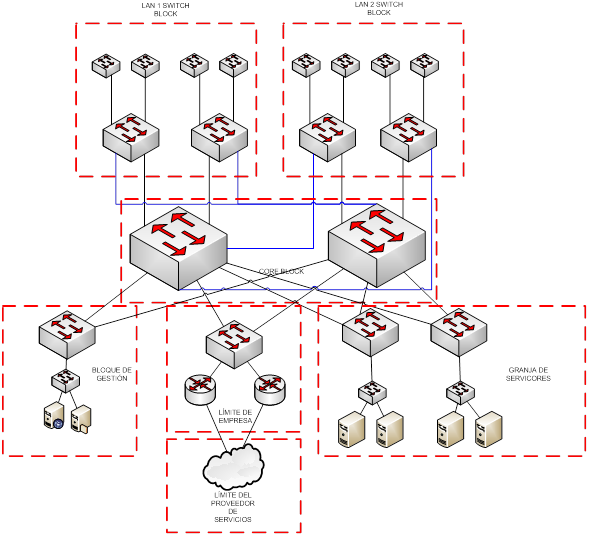
The ECNM (Enterprise Composite Network Model) also uses these three layers, but in this case it refers to them as blocks: the switching block and the core block. The switching block includes both the access layer and the distribution layer, while the core block includes the core layer.
This is the model that Cisco recommends, and it advises us to use a block-based approach to design a network. Thus, each LAN within a campus network will be a switching block, and each of these blocks, connected through the core block, will form the network.
You can use the switching block diagram for:
[icon_check][/icon_check] a LAN
[icon_check][/icon_check] a farm in servers
[icon_check][/icon_check]Internet access
[icon_check][/icon_check]network monitoring services.
In this diagram, you can see more clearly how the Cisco network would be configured:
These are the general guidelines; in addition, you must remember that the network must be redundant, fault-tolerant, and, of course, scalable.
If you'd like to learn more, download our Network Design Guide, where you'll find much more detailed information on how to design your Cisco network.
[gravityform id="1" name="Download Our Social Media Guide"]