3 Solutions to Your IT Hardware Maintenance Challenges
Turning off the lights isn't an option, but we can always find a way to make your hardware maintenance as efficient as possible.
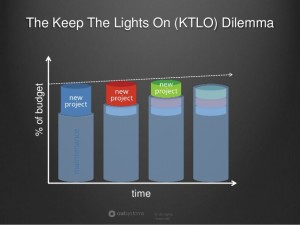
Organizations want to devote more time and resources to innovation. Unfortunately, more than 50% of the IT budget is spent on (KTLO) maintaining the lights on. Gartner says it’s 80–85%, while Forrester states it’s 70–75% of technology budgets. In any case, the point is that a large portion of a company’s IT budget is allocated solely to keeping the system running.According to Gartner, there is a need to optimize costs—particularly for post-warranty and EOSL (End of Service Life) support for data centers and network devices—given the growing demand for alternatives to OEM support.
Here are three recommendations for addressing your company’s IT hardware maintenance challenges.
1. Strategic Roadmap for Your IT Infrastructure
Information and communications technologies (ICT) are now an essential part of any company’s daily operations and strategic capabilities. These should be viewed as the set of resources that will enable the company to perform better, achieving a greater competitive advantage [Hedmanet et al., 2002]
A mapped view of the company’s network infrastructure allows you to take inventory of your IT assets and provides comprehensive information about your entire network. With a visual understanding of the network layout, the IT team can easily identify potential bottlenecks and help troubleshoot issues when a problem arises.
This is also a crucial step in distinguishing between what your company actually needs and what original equipment manufacturers (OEMs) claim you need. It will help you assess whether you truly need the new product line and maintenance contract upgrade they are offering.
 With the tremendous strides technology has made—offering greater capabilities in connectivity, integration, and performance, coupled with a more aware and receptive corporate culture— ICT has become a strategic player, providing organizations with a competitive advantage; moreover, it has enabled organizations to position themselves in such a way that they can better address changes and challenges. ICT has become the fundamental tool for supporting, maintaining, and growing the business, to the point of creating a critical dependency on ICT [Gordon et al., 2002].
2. Review of the Service Level Agreement (SLA)
The Service Level Agreement (SLA) is a contractual document that defines the quality levels committed to for a contracted service. Although not exclusive to this type of contract, the SLA is a standard component of many IT and telecommunications service contracts (IT outsourcing, hosting, housing, help desk, communication networks, ISPs, SaaS, etc.), and it is arguably in the field of information technology where the most comprehensive methodologies and best practices regarding its drafting and management have been developed, as is the case with the section of ITIL dedicated to service management.
With the tremendous strides technology has made—offering greater capabilities in connectivity, integration, and performance, coupled with a more aware and receptive corporate culture— ICT has become a strategic player, providing organizations with a competitive advantage; moreover, it has enabled organizations to position themselves in such a way that they can better address changes and challenges. ICT has become the fundamental tool for supporting, maintaining, and growing the business, to the point of creating a critical dependency on ICT [Gordon et al., 2002].
2. Review of the Service Level Agreement (SLA)
The Service Level Agreement (SLA) is a contractual document that defines the quality levels committed to for a contracted service. Although not exclusive to this type of contract, the SLA is a standard component of many IT and telecommunications service contracts (IT outsourcing, hosting, housing, help desk, communication networks, ISPs, SaaS, etc.), and it is arguably in the field of information technology where the most comprehensive methodologies and best practices regarding its drafting and management have been developed, as is the case with the section of ITIL dedicated to service management.
 Companies often renew maintenance contracts due to the current situation. Make sure the service level agreement (SLA) meets your needs. Without an appropriate contractual framework, the Service Level Agreement is nothing more than a zombie that appears to be alive but isn’t.
3. Know Your Options
It’s not a dead end. If your current contract is no longer available, you should be aware of your alternatives.
Working with a third-party hardware maintenance provider is more beneficial for your company due to its flexibility and personalized support. It’s also more cost-effective. According to Gartner, “TPM contracts offer customers an average of 60% savings compared to OEM list prices for support.” However, depending on the type of equipment, location, and product density, Gartner has found that savings with TPM contracts range from 50% lower than OEM prices to as much as 95%.
With third-party hardware maintenance, you can free up more than 50% of your IT budget and redirect it toward innovation or the purchase of additional equipment.
Companies often renew maintenance contracts due to the current situation. Make sure the service level agreement (SLA) meets your needs. Without an appropriate contractual framework, the Service Level Agreement is nothing more than a zombie that appears to be alive but isn’t.
3. Know Your Options
It’s not a dead end. If your current contract is no longer available, you should be aware of your alternatives.
Working with a third-party hardware maintenance provider is more beneficial for your company due to its flexibility and personalized support. It’s also more cost-effective. According to Gartner, “TPM contracts offer customers an average of 60% savings compared to OEM list prices for support.” However, depending on the type of equipment, location, and product density, Gartner has found that savings with TPM contracts range from 50% lower than OEM prices to as much as 95%.
With third-party hardware maintenance, you can free up more than 50% of your IT budget and redirect it toward innovation or the purchase of additional equipment.
 Finally, especially in long-term contracts, it is advisable for the contract to provide for a procedure for periodically reviewing the SLA, so that it can be improved as the provider gains experience, technology advances, and so on. In any case, these types of provisions have a significant impact on the provider’s business case (e.g., the provider may have factored in the efficiencies it will achieve by gaining experience or through technological improvements when setting the price) and should be discussed openly and negotiated with sufficient flexibility. It is also possible to link this provision to a benchmarking process that simply positions the contract within the market, taking into account the quality provided for the price paid.
Optimize the performance of your IT environment while reducing unnecessary costs. Our comprehensive maintenance solutions will provide the security your business needs at the lowest cost. We’ll also guide you through our services to reduce the number of incidents. We anticipate problems, minimize their impact, and seek reliable, secure, and cost-effective solutions. Contact us!
Finally, especially in long-term contracts, it is advisable for the contract to provide for a procedure for periodically reviewing the SLA, so that it can be improved as the provider gains experience, technology advances, and so on. In any case, these types of provisions have a significant impact on the provider’s business case (e.g., the provider may have factored in the efficiencies it will achieve by gaining experience or through technological improvements when setting the price) and should be discussed openly and negotiated with sufficient flexibility. It is also possible to link this provision to a benchmarking process that simply positions the contract within the market, taking into account the quality provided for the price paid.
Optimize the performance of your IT environment while reducing unnecessary costs. Our comprehensive maintenance solutions will provide the security your business needs at the lowest cost. We’ll also guide you through our services to reduce the number of incidents. We anticipate problems, minimize their impact, and seek reliable, secure, and cost-effective solutions. Contact us!