Natural resources are a source of value, but they are finite. This has highlighted the need for a more responsible model of production and use in recent years. The uncontrolled extraction of these resources not only depletes them but also significantly increases energy consumption and greenhouse gas emissions (not just CO2).
The recent shift in workplace practices toward remote and cloud-based models has caused a global surge in energy and IT consumption.
Sustainability and Technology
Sustainability has long since ceased to be an option, and sustainable technology has emerged as an essential element of this entire strategy for a business paradigm shift. At MercadoIT, our motto is “Rethink, Reimagine, Retech”—a concept that reflects the need to rethink the economic model in which we live and how we use technology; to reimagine a new business model in which sustainable technology is the first choice; and “Retech,” as our core business, which involves refurbishing professional network infrastructure technology for companies.
We remain focused on improving our technological resources, capabilities, and compliance with global sustainability goals, in line with our customers' evolving needs and changing legislative requirements regarding sustainability.
We have been working tirelessly for more than ten years to ensure not only that your equipment operates optimally, but also to offer you the highest-quality equipment with the best warranty, at the best price, and with the leading related services to extend its useful life by up to 80%.
One of the benefits of this is ensuring not only the security of your equipment and data, but also minimizing our environmental impact by leveraging our expertise, our in-house sustainability department, our external consulting with leading experts, and the ISO 14001 certification system to maintain the highest standards and foster team awareness to closely monitor the achievement of both economic and environmental goals.
So, what is sustainable technology?
Sustainable technology is technology that takes natural resources into account and promotes economic and social development. The goal of these technologies is to drastically reduce environmental and ecological risks and create a sustainable product. In this field, the focus is not only on innovation and new technologies, but increasingly on the reuse of existing ones. MercadoIT’s technology refurbishment program was created with this goal in mind.
Sustainability in technology can be defined in several ways:
– Substitution. Technology promotes the use of different materials in production and the replacement of parts or components to extend the product’s useful life. It also replaces non-renewable resources with renewable ones.
– Prevention. Sustainable technology reduces degradation, pollution, and other negative environmental impacts resulting from its use or production.
– Efficiency. Sustainable and refurbished technology is more efficient in terms of energy and resource use, as it extends the service life of equipment, avoids unnecessary production, transportation, and installation, and fully complies with technical requirements.
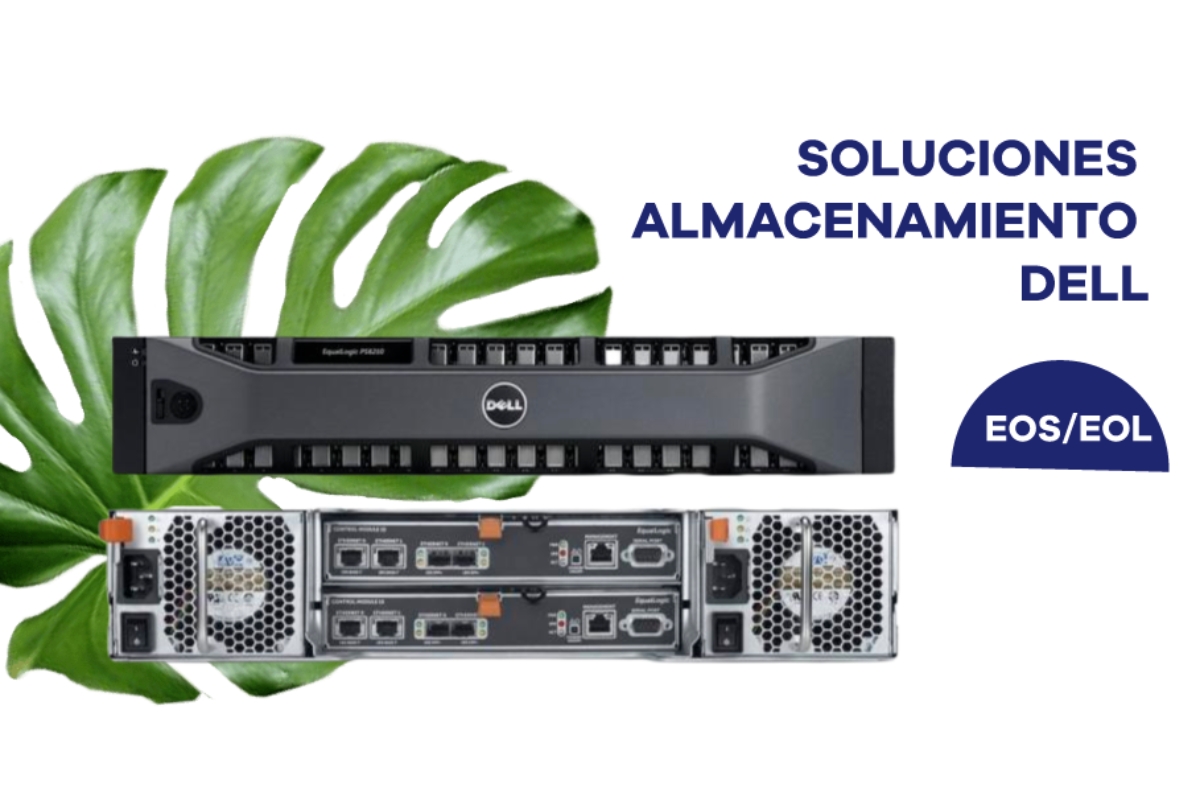
MercadoIT works with EOS/EOL technology that manufacturers no longer support. That's sustainable technology.
Over time, equipment is eventually classified as EOS/EOL, where EOL stands for "end of life"—the point at which the OEM considers the equipment to have reached the end of its useful life and ceases production.
EOS is defined as the end of support, after which the manufacturer (OEM) discontinues technical services and software updates for server, storage, and networking equipment. It will not renew, sell, or update hardware maintenance (support) contracts.
This is where the technical expertise of companies like MercadoIT comes into play; they base their business model on the concept of breaking away from planned obsolescence as a selling point, and on the certainty that this equipment still has a long useful life—both in terms of hardware and software—and can continue to function at 100% capacity in businesses while maintaining all its features. MercadoIT is Spain’s leading company in equipment refurbishment, TPM maintenance services, and the installation and support of professional IT equipment.
Commitment from Major Market Players
When it comes to sustainability in technology, companies like Microsoft are rigorously pursuing the SDG goals. Responsible technology governance is a necessity, and Microsoft has already committed to becoming carbon-negative, water-positive, and zero-waste by 2030. Moreover, it doesn’t stop there; its goal is to eliminate all the CO2 the company has emitted since its founding in 1975 by 2059. These are truly ambitious commitments.
SDGs and Sustainable Technology
The United Nations 2030 Agenda for Sustainable Development includes 17 goals—known as the Sustainable Development Goals (SDGs)—and 169 sustainable development targets for the period from 2016 to 2030.
Several of these goals are directly relevant to our work at MercadoIT. Thanks to our sustainability department, our internal committee, and professional external consulting, we have been able to identify the key areas where we have the greatest impact and determine how we can reduce our negative impact and enhance our positive impact.
The SDGs most closely aligned with our business activities are as follows:
SDG 8 – Decent Work and Economic Growth
We promote decent work and contribute to economic growth in the business community, as well as at the local and national levels.
SDG 12 – Responsible Production and Consumption
Refurbishing and working with sustainable technology allows us to adapt to your needs and ensure that your equipment operates flawlessly for longer. In this way, we rethink the use of both natural and technological resources.
SDG 13 – Climate Action
Each year, we prevent the production and disposal of an average of 75 metric tons of electronic waste. We help preserve natural environments and reduce CO2 emissions.
SDG 17 - Partnerships for the Goals
Helping more and more companies adopt sustainable technology means forging a partnership between business and environmental commitments.
In addition, we are working to join forces with the public and private sectors and civil society to jointly contribute to sustainable and responsible development.
In addition to our key SDGs—where we are able to generate more positive impact while reducing negative impact—our goal goes even further, and we have recently developed plans that expand on these objectives through our CSR initiatives.
SDG 4 – Education and Quality
Making sustainable, high-quality technology more accessible to more people means improving their educational resources and helping to bridge the digital divide.
SDG 5 – Promote actions to end inequality and facilitate the full and effective participation of women in leadership positions, particularly in STEM fields.