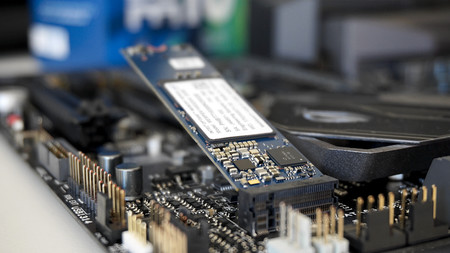
A simple USB flash drive (or USB memory stick) is an example of solid-state drive (SSD) technology. An SSD is a larger, more complex device that combines arrays of NAND flash memory—the type of storage also found in MP3 players and digital cameras. Unlike RAM, which does not retain data when the machine is turned off, SSD flash memory is non-volatile, meaning that data is preserved whether the device is powered on or off.
With SSDs, each block of data can be accessed at the same speed as any other block, regardless of its location. This makes SSDs inherently faster than hard disk drives, where the platters spin and the drive heads move to the correct location.
With hard disk drives, large files can be split up and stored in unused nooks and crannies of the drive, and data can be easily updated in place. This allows for efficient use of the hard disk’s total capacity. On the other hand, scattered data obviously takes longer to locate, which is why defragmenting a hard drive has become a standard part of device maintenance.
Differentiation of SSDs
SSD hard drives have one difference that is also a disadvantage: SSDs can only write to empty blocks. That’s fine when the SSD is new and all the blocks are empty. But over time, as the blocks fill up, overwriting data becomes a problem, because the only way an SSD can update an existing page is to copy the contents of the entire block into memory, erase the block, and then write the contents of the old block along with the new data. If there are no empty blocks available, the SSD’s mechanism must search for blocks marked for deletion but not yet erased, erase them, and then write the data to the now-empty page. Over time, as the SSD fills up, writing to the drive becomes more complicated and slower.
SSD hard drives use a combination of methods to overcome this problem, including overprovisioning; wear leveling, a type of load balancing for flash cells; and garbage collection, a process that runs in the background to remove obsolete files and optimize available space, similar to the defragmentation feature on HDDs.
Should You Buy SSDs or HDDs for Your Business?
SSDs have a number of advantages over HDDs that can help offset the price difference. SSDs are silent. They don’t vibrate, which improves reliability. If dropped, a hard drive could be damaged; this isn’t the case with an SSD. They use less power and generate less heat, which can add up to significant savings in a data center setting. They’re also smaller and more powerful than HDDs, so data centers can store more data in less space. And, of course, there’s the advantage of speed.
Given that HDD hard drives have a massive customer base that essentially considers them to be “good enough,” the decision to adopt a new and different technology requires companies to develop a solid business case.
Companies should conduct a detailed cost-benefit analysis to determine whether switching to SSDs makes sense. One implementation approach would be a gradual migration, in which SSDs would be required for new servers and storage devices. Another approach is to use SSDs exclusively for “Level 0” data in a tiered data storage scenario. Level 0 data consists of transactional data that requires high performance, such as in financial or e-commerce applications.
Other enterprise use cases for SSDs include computers or laptops running applications where boot time is critical, editing large multimedia files such as video and audio, cache drives, and database servers.
While companies are considering purchasing SSDs instead of HDDs, it is important to keep in mind that the total volume of data is skyrocketing, so most companies will continue to purchase both types of drives for a long time to come. In MercadoIT We offer a wide range of SSDs and HDDs from leading brands, and we can also help you with configurations for your data center. Please feel free to contact us—there’s no obligation.