RAID Level 5 - Striping with parity
RAID 5 is one of the most common levels of
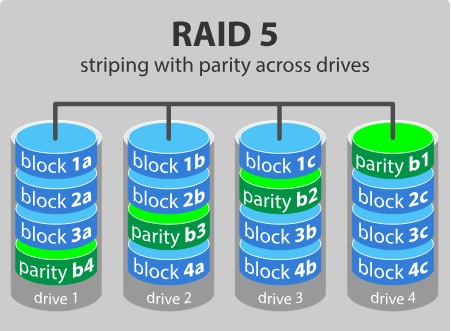
data storage. It requires at least 3 hard drives, but can work with up to 16. Data blocks are distributed across the drives, and a parity checksum of all the block data is written to one drive. The parity data is not written to a fixed drive; instead, it is distributed across all drives, as shown in the following diagram. Using the parity data, the computer can reconstruct the data from one of the other data blocks if that data is no longer available. This means that a RAID 5 array can withstand the failure of a single drive without losing data or losing access to it. Although RAID 5 can be implemented via software, a hardware controller is recommended. Often, additional cache memory is used in these controllers to improve write performance.
Advantages of RAID 5
Data read transactions are very fast, while data write transactions are somewhat slower (due to the parity that must be calculated).
If a drive fails, you still have access to all the data, even while the faulty drive is being replaced and the storage controller is rebuilding the data on the new drive.
RAID 5 is a complex technology. If one of the disks in an array using 4TB disks fails and is replaced, restoring the data (the rebuild time) can take a day or more, depending on the load on the array and the speed of the controller. If another disk fails during that time, the data is lost forever.
In summary, RAID 5 is a well-rounded system that combines efficient storage with excellent security and performance. It is ideal for file servers and applications that have a limited number of data drives.
RAID Level 6 – Striping with double parity
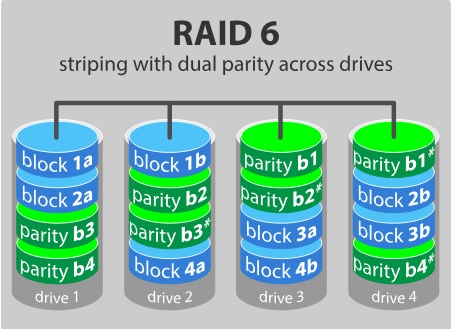
RAID 6 is like RAID 5, but parity data is written to two drives. That means it requires at least 4 drives and can withstand the simultaneous failure of 2 drives. The chances of two drives failing at exactly the same time are, of course, very small. However, if a drive in a RAID 5 system fails and is replaced with a new one, it takes hours or even more than a day to rebuild the replaced drive. If another drive fails during that time, all of its data is lost. With RAID 6, however, the RAID array would still be able to recover the data.
Is RAID 6 the best data storage system?
As with RAID 5, data read operations are very fast.
If two drives fail, you still have access to all the data—even while the faulty drives are being replaced—which confirms that RAID 6 is more reliable than RAID 5.
However, data write operations are slower than with RAID 5 because additional parity data must be calculated. I read in a report that write performance was 20% lower.
It is a complex technology, and rebuilding an array in which a drive fails can take a long time.
In summary, RAID 6 is a good all-around system that combines efficient storage with excellent security and decent performance. It is preferable to RAID 5 for file servers and applications that use many large drives for
data storage.
We hope you found this article helpful, and if you have any questions regarding server solutions, please don’t hesitate to
Contact Us. To view all data storage tiers, read the article
RAID Types and Their Characteristics.