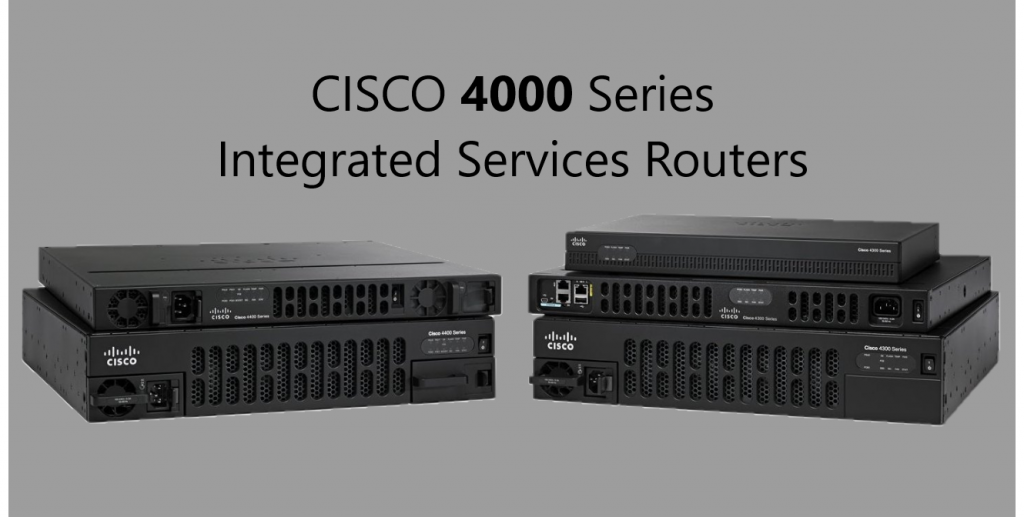
A few months ago, Cisco introduced the 4000 series of routers. Our technicians have received a surprising number of inquiries regarding this announcement, so that’s why we’ll be discussing the Cisco 4000 routers today.
Routers are vital components of enterprise networks, and the Cisco 4000 router family is a major upgrade from the older families of 1900 routers/2,900/3,900.
When analyzing the layout of an enterprise network, well-planned routing is the key to success. Routers can be absolutely vital to networks, as they connect a large number of work sites within a large network. At the enterprise level, they provide redundant paths, connect ISPs, and can translate data between different media.
In addition to routing packets to the correct destination, routers will select alternative routes when a link is compromised or traffic is heavy. Routers—particularly Cisco routers—function as a default gateway. And Cisco’s 4000 series of routers, although they’ve been on the market for a while, are worth another look.
The Cisco 4000 series of routers is a major update to the older 1900, 2900, and 3900 series, although they aren't actually that different.
What's New in the Cisco 4000 Series Routers
The Cisco 4000 Series has the following features:
• Wide range of performance levels: from 35 Mbps to 2
Gbps• All models, except for the smallest one (the 4221), have OIR (online insertion and removal) capability for NIMs•
Significant increase in maximum RAM (up to 16 GB on some models)
• Uses the same set of IOS software features and licensing model as the previous ISR G2 series
Below is a list of Cisco 4000 series router models available on MercadoIT:
| ISR4451-X/K9 | ISR 4451 with 4 onboard GE ports, 3 NIM slots, 1 ISC slot, 2 SM slots, 8 GB of flash memory (default), 2 GB of DRAM (default, data plane), and 4 GB of DRAM (default, control plane) |
| ISR4431/K9 | ISR 4431 with 4 onboard GE ports, 3 NIM slots, 1 ISC slot, 8 GB of flash memory (default), 2 GB of DRAM (default, data plane), and 4 GB of DRAM (default, control plane) |
| ISR4351/K9 | ISR 4351 with 3 onboard GE ports, 3 NIM slots, 1 ISC slot, 2 SM slots, 4 GB of flash memory (default), and 4 GB of DRAM (default) |
| ISR4331/K9 | ISR 4331 with 3 onboard GE ports, 2 NIM slots, 1 ISC slot, 1 SM slot, 4 GB of flash memory (default), and 4 GB of DRAM (default) |
| ISR4321/K9 | ISR 4321 with 2 onboard GE ports, 2 NIM slots, 1 ISC slot, 4 GB of flash memory (default), and 4 GB of DRAM (default) |
| ISR4221/K9 | ISR 4221 with 2 onboard GE ports, 2 NIM slots, 1 ISC slot, 8 GB of flash memory (default), and 4 GB of DRAM (default) |
There are two performance tiers per router: Cisco has taken the performance licenses originally used in its powerful ASR router line and adapted them for the 4000 series routers. If you purchase any of the Cisco 4000 routers, they will come standard with the lower of the two performance tiers. Later on, as your requirements grow, you can purchase a Cisco performance upgrade license—and you’re all set!
At MercadoIT, we use Cisco routers in the solutions we offer to address a variety of challenges and to keep our clients' businesses running smoothly and efficiently. Having the right Cisco router will not only allow you to manage networked computers but will also give you more time to focus on your various responsibilities throughout the day.
Whether you're managing a call center, helping the CEO get his WebEx up and running, or planning how your network can keep pace with your company's growth, choosing the right Cisco router definitely makes a difference.